Have you ever watched your favorite animated movie and wondered how those characters move so smoothly?
Well, there’s a new player in town that’s about to change everything.
AI motion synthesis tools are quietly revolutionizing how animators bring characters to life – and it’s pretty exciting stuff.
What is Motion Synthesis?
Think of motion synthesis as your animation assistant that never gets tired.
Instead of animators spending weeks moving characters frame by frame. These AI tools can generate realistic character movements automatically.
Here’s the amazing part: unlike those flashy AI video generators you’ve probably seen online, these tools work inside the software animators already use – like Maya, Blender, and Unreal Engine.
They don’t just provide you with a video you can’t edit. They give you actual 3D data that you can tweak, adjust, and perfect.
Why Animators Are Actually Excited
Catherine Hicks knows a thing or two about animation. She used to work at Pixar and now heads up animation innovation at Cartwheel, an AI startup focused on motion synthesis.
She discussed what gets animators most excited about their tool.
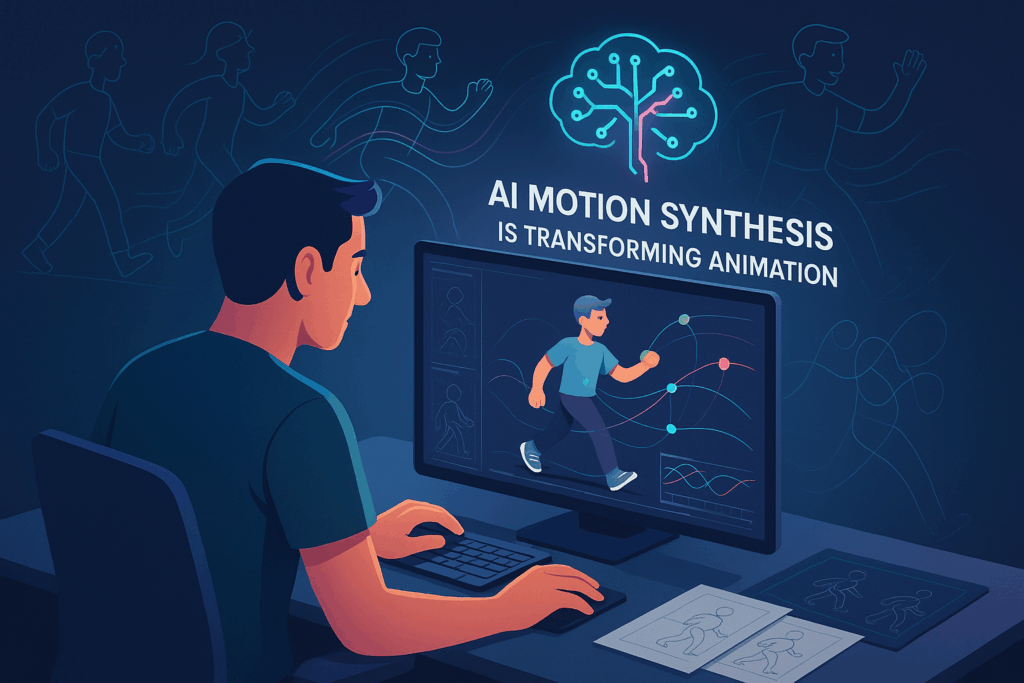
“Our tool takes a reference video that an animator uploads and figures out all the specific motion, joint positions, rotations, and how things move through space, then applies it to their 3D character,” Hicks explained.
Imagine you’re an animator working on a walking scene. Traditionally, you’d spend days creating each step, each arm swing, each subtle body movement.
With motion synthesis, you could upload a video of someone walking, and instantly, you see your character doing the same walk.
Then you spend your time on the fun stuff: adding personality, tweaking expressions, making it perfect.
How AI Helps with Time-Consuming Tasks
Let’s talk about something called “blocking” – it’s like the rough sketch phase of animation.
Animators create a basic version of scenes to show directors before diving into the detailed work. It usually takes weeks.
“For most animators, the first few weeks of working on their shot involve re-creating motion from a reference on their 3D puppet,” says Hicks.
“The ability to take a reference video and get motion from it really speeds up your blocking process.”
She’s talking about saving 2-3 weeks of work. That’s not just about efficiency – it’s about creativity.
When you can show a director your rough ideas weeks earlier, there’s more time for “what if we tried this instead?” moments.
Why Motion Synthesis Works Better Than Video AI
You’ve probably seen those AI video generators that create wild, dreamlike clips.
They’re fun, but they’re not great for professional work. Why? Control.
Directors and animators need to be able to say, “Make the character’s left hand move slightly higher” or “Can we adjust the walking speed?”
With video AI, you’re basically rolling the dice and hoping for the best. One animator described it as “vibe directing” – you get what you get.
Motion synthesis tools are different. They give you the building blocks, then let you build whatever you want.
It’s like the difference between getting a pre-made sandwich and getting all the ingredients to make your own perfect sandwich.
Data Sources and Legal Considerations
Here’s something that sets these tools apart from the controversial AI models making headlines.
Many motion synthesis tools are trained on “clean” data, meaning they use motion capture data and animations that were created legally and ethically, not scraped from the internet without permission.
Companies like Cartwheel and Maya’s MotionMaker trained their systems on motion capture data they own or licensed properly.
It’s a small but important difference that matters to studios worried about legal issues.
What This Means for Animation Jobs
Let’s be honest about the elephant in the room. Will AI replace animators?
Probably not entirely, but it will change what animators do.
Hicks puts it in perspective:
“Animation has experienced this many times before. We’re at one of these places again where the tools are changing. With every new technology comes new jobs, and changes to existing jobs.”
She’s right. When Disney started using Xerox machines, it eliminated floors of ink-and-paint artists.
When 3D animation took over, cel animation jobs disappeared. When motion capture arrived, it changed 3D animation jobs.
The pattern seems to be that specialists in narrow skills get displaced, while “generalists” – people who can adapt and use new tools creatively – thrive.
What This Means Going Forward
Instead of spending weeks on technical grunt work, animators might soon focus on what they do best: storytelling, character development, and bringing emotion to life.
The AI handles the heavy lifting of making characters move realistically, while humans focus on making them move meaningfully.
It’s like how word processors didn’t replace writers – they just made the typing part easier so writers could focus on the words that matter.
The animation industry is about to get a lot more interesting.
And honestly? The future where technology handles the tedious stuff while humans focus on creativity sounds pretty good to me.